Stay connected: follow us on LinkedIn and explore more at
www.CherryHillAdvisory.com.


.svg)
Subscribe now to join the Risk Register community:
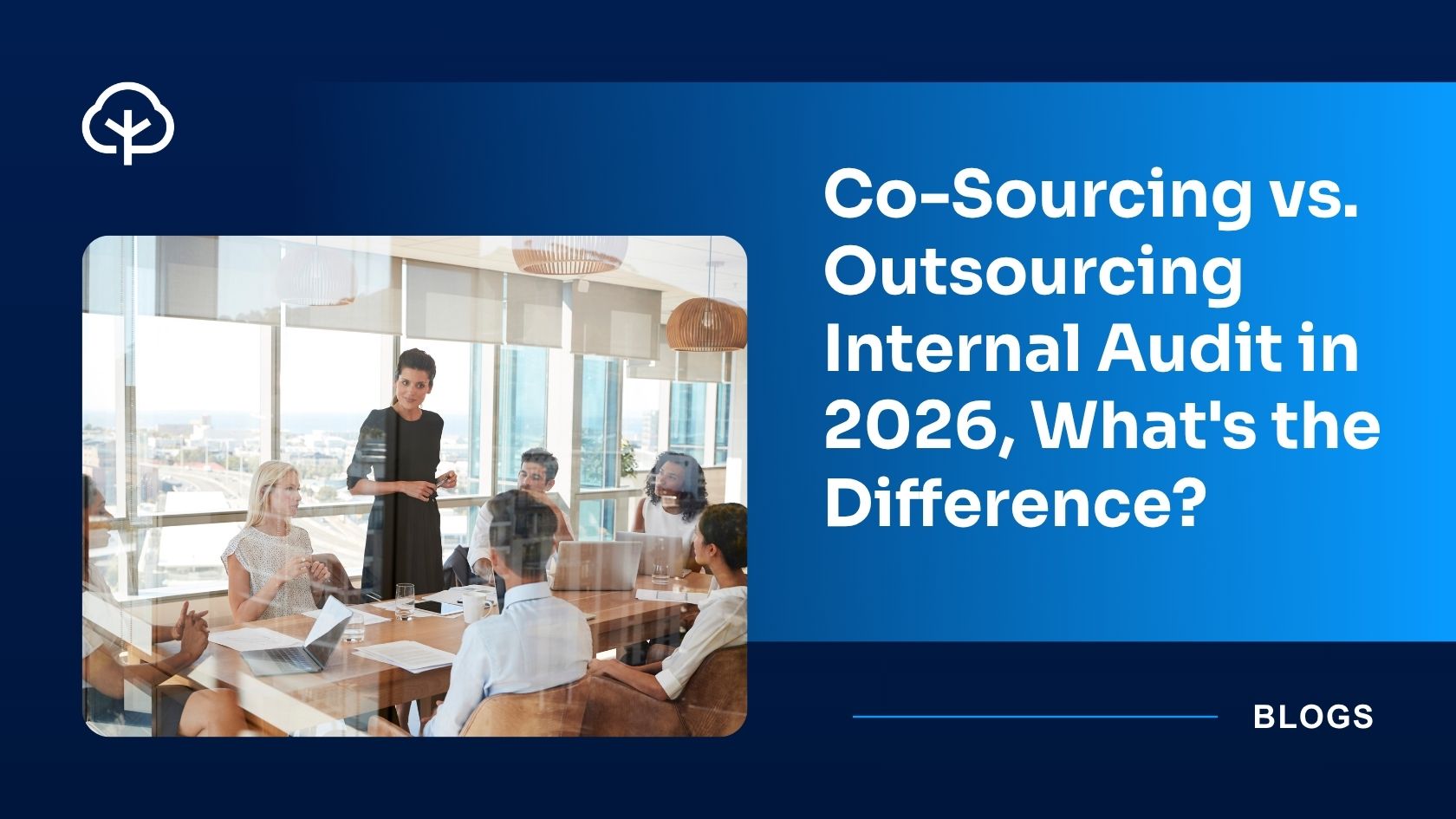
Most organizations that bring in outside audit support describe it the same way: "we outsourced internal audit." That framing is technically wrong in most cases, and the distinction is not just semantic. How you structure the relationship shapes who owns the work, who controls the audit agenda, and whether your internal audit function gets stronger or gradually hollows out. In 2026, with IIA Standards raising the bar on independence, competency, and quality, the model you choose has real consequences.
The simplest way to see the difference is to ask one question: who owns the audit plan? In a co-sourcing model, the Chief Audit Executive (CAE) or Head of Internal Audit still owns the audit universe, the risk assessment, the plan, and the findings. The external firm steps in to provide capacity or specialized expertise on specific engagements, but your team stays in the driver's seat. In a full outsourcing model, an external firm takes over the entire internal audit function. They plan it, staff it, execute it, and report the results. The CAE, if one exists at all, often becomes a contract manager.
The practical difference matters most at the audit committee level. An outsourced function means the committee is receiving assurance from a vendor. A co-sourced function means the committee is receiving assurance from your internal audit team, augmented with specialist support where it's needed. That distinction holds up in regulatory conversations in a way that "we contracted it out" often does not.
The 2024 Global Internal Audit Standards, issued by the Institute of Internal Auditors (IIA), reinforce why this distinction matters. The Standards make clear that when internal audit work is performed by external service providers, the CAE remains responsible for quality, objectivity, and due professional care. That accountability doesn't transfer to the vendor. It stays with the function.
For organizations that have fully outsourced internal audit, this creates a structural problem: accountability without authority. The CAE is on the hook for work they didn't direct and couldn't fully oversee. A co-sourcing arrangement sidesteps this cleanly. The CAE maintains authority over scope and methodology, works alongside the co-sourced team, and can attest to the quality of the output.
The financial argument for full outsourcing usually rests on cost: one contract line, one vendor relationship, lower per-head expense than building an in-house team. That arithmetic often looks right until you look at what gets lost. Internal audit capability is organizational knowledge. The team that knows where the exceptions get waived without escalation, which business unit consistently submits documentation late, and where the real control gaps live in accounts payable, that institutional knowledge disappears when the function is handed to an external firm.
According to the ACFE's 2024 Report to the Nations, organizations with stronger internal controls detect fraud significantly faster and recover more losses than those with weaker control environments. A function that cycles external staff every engagement loses the continuity that makes that detection work. Co-sourcing preserves the institutional knowledge inside your team. The external partner brings what your team doesn't have: specialized skills in cybersecurity risk, AI governance, SOX testing, or fraud investigation. When the engagement ends, your team is more capable than when it started. Full stop.
Independence is the anchor of everything internal audit does. The moment the function is seen as a vendor's product rather than a board-level assurance mechanism, its credibility with the audit committee erodes. Full outsourcing creates the optics problem even when the substance is fine. Audit committees increasingly understand this. In conversations with boards and CAEs, the question is no longer just "who's doing the work" but "who owns the function."
A co-sourced model lets you answer that clearly. Your team owns it. Cherry Hill works alongside your team. The assurance delivered to the board is yours; we helped you get there. What does a co-sourcing arrangement actually look like in practice? It might be a single specialized engagement: a cybersecurity risk review your team doesn't have the technical depth to run, or a fraud risk assessment triggered by a whistleblower complaint. It might be sustained capacity support during a busy quarter when staff are stretched. In either case, the work product is reviewed and stood behind by your CAE, not handed off to a third-party firm to present independently. You can see exactly how that model works through our internal audit co-sourcing services.
Full outsourcing of internal audit isn't always wrong. For organizations under a certain size or complexity, say, a private company without a regulatory mandate for internal audit that needs a periodic controls review, contracting the entire function to an external firm can be a reasonable answer. The problem is when organizations that have a real internal audit function, with board reporting obligations and regulatory expectations, move to a full outsourcing model because it looks cheaper. That's where the IIA Standards accountability problem shows up. It's also where audit committee confidence tends to decline over time.
The co-sourcing model scales better in both directions. You can bring in a specialist for four weeks to run a SOX walkthrough, then have them leave. You can embed a senior advisor for a quarter to augment capacity during a complex integration. None of this requires handing over your audit charter or your independence. Are you structured right to make that case clearly to your audit committee?
The risk landscape has changed faster than most internal audit teams have been able to hire for. AI governance is now an audit obligation for many organizations, not just a talking point. Cybersecurity risk requires technical depth that most generalist audit teams don't carry. Third-party risk under the IIA's Topical Requirements, effective September 15, 2026, adds another layer of complexity that hits vendor-heavy organizations especially hard. Co-sourcing exists to solve exactly this problem.
Your team knows your organization. Cherry Hill brings the specialized expertise, whether that's AI governance audit methodology, cybersecurity risk testing, or fraud investigation experience, without requiring you to hire a permanent specialist for a risk that may not demand full-time attention every year. The IBM Cost of a Data Breach 2023 Report found that organizations with high levels of security complexity faced average breach costs 18.2% higher than those with lower complexity, underscoring why specialized technical coverage in audit matters. The internal audit teams delivering the most value to their audit committees in 2026 are the ones that have figured out how to scale their capabilities without scaling their headcount.
There's a conversation worth having with your audit committee before the next planning cycle. Not "do you want us to outsource internal audit" but "what risk areas do you need internal audit to cover that you're not confident we can cover with current resources?" That reframe changes everything. It positions internal audit as a function solving for board needs rather than managing headcount. It opens the door for co-sourcing as a strategic capability tool. And it keeps the CAE in the role the IIA Standards require: accountable for quality, independence, and the overall assurance delivered to governance.
Internal audit has more influence than it often claims. The question is whether the function is staffed and resourced to exercise that influence. The next wave of risk, whatever form it takes, is coming. The organizations that will navigate it best are the ones where internal audit already has the right capabilities in place, built deliberately, not scrambled for after the fact. If your audit committee is asking questions your team doesn't have the specialist depth to answer today, that's exactly the gap co-sourcing is designed to close.
Cherry Hill Advisory works alongside internal audit teams to provide specialized co-sourcing support on complex engagements. If you're evaluating how to structure audit capacity for 2026 and beyond, explore our internal audit co-sourcing model or take a look at how an External Quality Assessment can benchmark where your function stands today.
Subscribe now to join the Risk Register community: